|
http://platea.pntic.mec.es/~aperez4/html/grecia/grecia.html
figura de Pitágoras está envuelta en
un halo de leyenda, misticismo y hasta de culto religioso.
Y no es tan extraño si pensamos que fue contemporáneo
de Buda, de Confucio y de Lao-Tse (los fundadores de
las principales religiones orientales)
El término "matemática", al
igual que el de filosofía, se le debemos a él.
¿Cuáles son las principales aportaciones
matemáticas de la escuela pitagórica?...
La primera y quizás la más importante
el introducir la necesidad de demostrar las proposiciones
matemáticas de manera inmaterial e intelectual,
al margen de su sentido práctico. Los pitagóricos
dividieron el saber científico en cuatro ramas:
la aritmética o ciencia de los números
- su lema era "todo es número" -, la
geometría, la música y la astronomía.
Pitágoras descubrió que existía
una estrecha relación entre la armonía
musical y la armonía de los números.
Si pulsamos una cuerda tirante obtenemos una nota.
Cuando la longitud de la cuerda se reduce a la mitad,
es decir en relación 1:2 obtenemos una octava.
Si la longitud era 3:4 obtenemos la cuarta y si es 2:3
tenemos la quinta.
Pero lo que colmó de gozo a Pitágoras,
hasta el punto de mandar sacrificar un buey a los dioses,
fue la demostración del famoso teorema. Por desgracia,
el secreto que imponía las normas de la sociedad
ha hecho imposible que esta demostración llegue
a nuestro conocimiento, aunque podemos deducir que no
sería muy distinta de la que Euclides nos brinda
en sus Elementos.
Sin duda es el teorema que cuenta con más número
de demostraciones.
Scott Loomis reunió y publicó a principios
de este siglo 367 demostraciones.
| Pythagoras is one of the most famous
mathematicians. He was born in Samos, Greece around
582 B.C. and he died around 475 B.C. Although he
made many important contributions to math we do
not know much about him. We do not have anything
that he wrote because he was the leader of a secret
society where they didn’t write down what
they did. All that we have about Pythagoras are
a few biographies from a long time ago.
Some accounts state that Pythagoras went to Egypt
in about 535 B.C. to learn more about mathematics
and astronomy. In Egypt Pythagoras visited many
of the temples and talked to the priests, but
he was not allowed in any of the temples except
for one. In 525 B.C. the king of Persia invaded
Egypt and Polycrates sent 40 ships to help the
Persians invade Egypt. During the invasion Pythagoras
was captured and taken to Babylon. After Polycrates
and the king of Persia died Pythagoras went back
to Samos, but nobody knows how he was freed.
( http://library.thinkquest.org/J0110961/pyth.htm
|
|
| Pythagoras also experimented with music. He found
a relationship between music and math. Pythagoras
found the relationship one day when he was walking
past a blacksmith shop and heard the hammers hit
the anvil. When Pythagoras heard the hammers hit
the anvil he noticed that each hammer made a different
sound according to the weight of the hammer. So,
the weight of the hammer (i.e. number) decides the
sound the hammer will make. What Pythagoras found
out was that math controls the tone of music.
http://library.thinkquest.org/J0110961/pyth.htm |
|
| La estrella pitagórica |
|
| "Eso que es siempre lo mismo"
o la esencia constante de la belleza podría
consistir de por ejemplo las proporciones en las
dimensiones. Esta idea se atribuye a Pitágoras
(ca. 532 AC) del que se dice que había
descubierto el hecho de que ciertas proporciones
aritméticas en los instrumentos musicales,
como las longitudes de las cuerdas, producen armonía
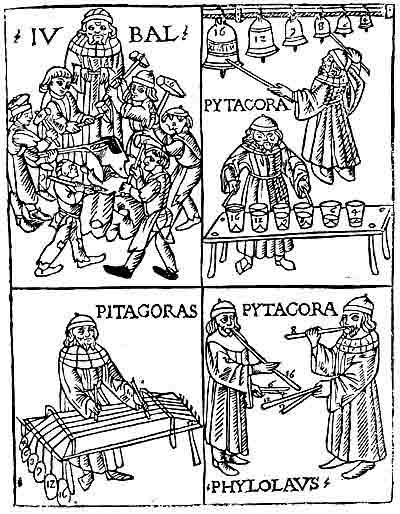
de tonos (a la derecha, una ilustración
de la Theorica Musice, de Gafurio, 1492). Sobre
la base de estas armonías musicales los
griegos intentaron explicar también la
belleza en las proporciones del cuerpo humano,
de la arquitectura y otros objetos.
Vitruvio (I:III:2) decía que un edificio
es bello cuando la apariencia de la obra es agradable
y de buen gusto, y cuando sus miembros son de
las debidas proporciones de acuerdo a los principios
correctos de "simetría" (donde
"simetría" significa "una
concordancia correcta entre los miembros de la
obra misma, y relación entre las diferentes
partes y el esquema general del conjunto en concordancia
con una cierta parte elegida como estándar.
-- La definición de simetría se
encuentra en I:II:4).
Durante la Edad Media, las proporciones y relaciones
numéricas fueron consideradas atributos
importantes de los objetos, como se puede ver
en el "libro de esbozos" de Villard
de Honnecourt, del s. XIII, una ilustración
de lo cual se ve a la izquierda. El documento
no contiene explicación para estas figuras.
El Renacimiento reavivó de nuevo el estudio
de las proporciones pitagóricas.
PYTHAGOREAN HARMONICS: FROM PYTHAGORAS TO NEWTON
Associated to Place: Hellas > articles -- by
* DIonysia Xanthippos (50 Articles), Historical
Article 1 Featured May 23 , 2005
by DIonysia Xanthippos and Sileinos Socrates
Musical chords and ratios, as demonstrated by
Pythagoras. A woodcut from the THEORICA MUSICE,
Naples, 1492, by Franchino Gafurio, music theorist
and choirmaster of Milan cathedral.In this late
medieval or early Renaissance woodcut, Pythagoras
is shown discovering the physical and mathematical
ratios that underlie the basic chords and the
most harmonious musical intervals. Tradition says
that after noticing the different sounds of blacksmiths’
hammers, Pythagoras embarked on the experiments
shown here: striking bells, water glasses and
strings; and blowing flute pipes. The hammers,
bells, glasses, strings and pipes are labelled
4, 6, 8, 9, 12 and 16, to indicate their weights
and sizes; and each experiment supposedly demonstrates
the same interval or chord: the octave, whose
ratio is 1/2 or 1:2, shown here as the ratio 8:16.
In the panel at upper left Pythagoras watches
the blacksmiths take turns hitting an anvil. One
strikes the base note, soon to be followed by
its octave, supposedly sounded by the 8-pound
hammer at the upper right. In a charming attempt
at reconciling Christian piety with pagan wisdom,
the artist has relabelled the Pythagoras figure
as IV BAL — Latin lettering for JUBAL, whom
the Bible declares to be the father of music.
In the panel at upper right Pythagoras is shown
striking two bells at once: a size 8, or 8-pound
bell, and a bell twice as big (#16), supposedly
producing an octave, whose ratio is therefore
8/16 or 1/2. Just below he is shown performing
the same experiment with glasses filled with varying
amounts of water. Here 8 and l6 ounces also produce
the high and low tones of an octave. By adding
several more glasses, and rubbing their rims instead
of striking them with sticks, Pythagoras could
have invented the Glass Harmonica that Benjamin
Franklin (re)invented and for which Mozart composed
a delightful piece. In ancient Greece, however,
even centuries after Pythagoras, even unblown
glass was surprisingly rare and expensive. So
it is doubtful that Pythagoras ever tinkered with
glassware of any sort. Or with bells, for that
matter.
In the panel at lower left Pythagoras is shown
striking with sticks six stretched strings of
ox sinews and sheep guts. Instead of a single
string “stopped” at different lengths,
or several strings of different lengths, the strings
are "tuned" by different tensions —
stretched by different weights. Pythagoras is
striking the two strings whose weights are labelled
8 and l6, again supposedly producing an octave.
The artist has been a bit careless, however, and
it looks as if Pythagoras might be hitting instead
the strings stretched by the 9 and l2 pound weights.
In that case, he would be sounding the chord called
a "fourth," whose ratio is 3:4 (= 9:12).
In the lower right panel Pythagoras, assisted
by his disciple Philolaus, demonstrates the harmonic
chords and ratios with flute pipes. Here also
the chord being played is the octave, with Philolaus
sounding the base note on a pipe l6 units long,
while his master blows a pipe half its length,
one labelled 8.
What these five experiments supposedly show is
that the harmonic chord or interval called the
octave always corresponds to a mathematical and
physical difference whose ratio is 1:2.
|
 |
By using other pairs of the instruments in
each series Pythagoras and his followers could
demonstrate the mathematical ratios underlying
other basic chords or intervals. Thus, bells,
strings or pipes sized, weighted, cut or stopped
in the ratios 6 to 9 (= 2:3) were said to produce
the chord or harmonic interval called a "fifth."
And those sized or weighted 9 and 12 (= 3:4) would
produce a chord or interval called the "fourth."
Why, then, does the series of numbers in the
woodcut run from 4 to 16? For simplicity, why
aren't there just four basic weights and lengths
here, labelled 1, 2, 3 and 4? The reason is that
theorists wanted to include the ratio for the
interval between two whole tones on the musical
scale, which has the seven whole notes plus the
octave: Do re mi fa sol la ti do. The ratio for
the physical difference between two successive
whole notes is 8:9. In other words, a string has
to vibrate along 8/9ths of its length to produce
a tone that is one whole note above the base note
produced by its entire unstopped length. Therefore
the ratio for the interval between these two notes
is 8:9. And the series of numbers from 4 to 16
is the smallest series that includes this ratio
in addition to the ratios for the octave (1:2
= 8:16) and those for the fifth and fourth.
http://www.ancientworlds.net/aw/Article/568210
A la derecha, un estudio de Leonardo, que muestra
la relación 1:3:1:2:1:2 en las proporciones
del rostro humano.
(Img: www.eticayempresa.com/arteologia/255.htm)
Musical chords and ratios, as demonstrated by
Pythagoras. A woodcut from the THEORICA MUSICE,
Naples, 1492, by Franchino Gafurio, music theorist
and choirmaster of Milan cathedral |
|
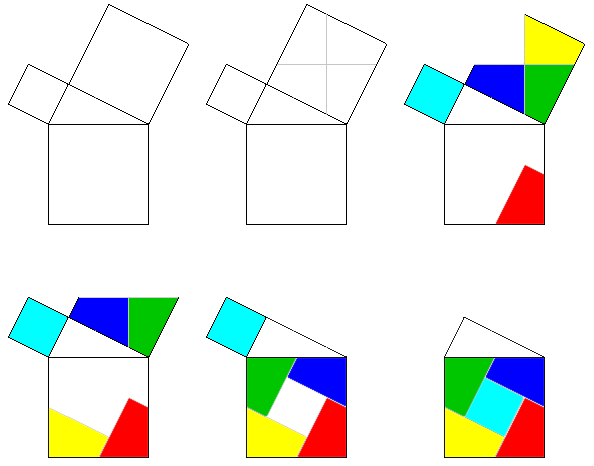
Demostración del matemático inglés
Henry Perigal al que se le atribuye una ingeniosa
comprobación del teorema de Pitágoras.
Sobre el mayor de los cuadrados construidos sobre
los catetos se determina el centro (no necesariamente
ha de ser este punto) y se trazan dos rectas paralela
y perpendicular a la hipotenusa del triángulo.
Con las cuatro piezas obtenidas más el
cuadrado construido sobre el otro cateto podemos
cubrir el cuadrado contruido sobre la hipotenusa.
( Img:www.arrakis.es/ ~mcj/teorema.htm) |
|
Otra demostración del teorema de pitágoras.
En este vemos cumo el cuadrado de la derecha coincide
exactamente en el centro de otro cuadrado formado
por las secciones resultado de la descomposición
de otro cuadrado que tiene concretamente el doble
de su área.
( Img:Enrique Rebasa. Escuela
de Arquitectura de Madrid.) |
|
Pythagoras of Samos (560BC - 480BC)
"Through Vibration comes Motion
Through Motion comes Color
Through Color comes Tone"
He was a Greek philosopher who was responsible for
important developments in the history of mathematics,
astronomy, and the theory of music. He founded the Pythagorean
Brotherhood and formulated principles that influenced
the thoughts of Plato and Aristotle. The influence of
Pythagoras is so widespread, and coupled with the fact
that no writings of Pythagoras exist today, this short
article will attempt to guide the reader through the
life of this most remarkable teacher.
He traveled widely in his youth with his father Mnesarchus,
who was a gem merchant from Tyre. His family settled
in the homeland of his mother, Pythais, on the island
of Samos, where he studied with the philosopher Pherekydes.
He was introduced to mathematical ideas and astronomy
by Thales, and his pupil Anaximander in Miletus when
he was between 18 and 20 years old. Thales advised Pythagoras
to travel to Egypt to learn more of these subjects.
Leaving Miletus, Pythagoras went first to Sidon, where
he was initiated into the mysteries of Tyre and Byblos.
It is claimed that Pythagoras went onto Egypt with a
letter of introduction written by Polycrates, making
the journey with some Egyptian sailors who believed
that a god had taken passage on their ship. Arriving
in Egypt, Pythagoras tried to gain entry into the Mystery
Schools of that country. He applied again and again,
but he was told that unless he goes through a particular
training of fasting and breathing, he cannot be allowed
to enter the school. Pythagoras is reported to have
said, " I have come for knowledge, not any sort
of discipline." But the school authorities said,"
we cannot give you knowledge unless you are different.
And really, we are not interested in knowledge at all,
we are interested in actual experience. No knowledge
is knowledge unless it is lived and experienced. So
you will have to go on a 40 day fast, continuously breathing
in a certain manner, with a certain awareness on certain
points." After 40 days of fasting and breathing,
aware, attentive, he was allowed to enter the school
at Diospolis. It is said that Pythagoras said,"You
are not allowing Pythagoras in. I am a different man,
I am reborn. You were right and I was wrong, because
then my whole standpoint was intellectual. Through this
purification, my center of being has changed. Before
this training I could only understand through the intellect,
through the head. Now I can feel. Now truth is not a
concept to me, but a life."
He spent the next 22 years perfecting himself in mathematics,
astronomy, music, and was initiated into the Egyptian
Mysteries. When Cambyses II, the king of Persia invaded
Egypt in 525BC, he made Pythagoras his prisoner and
sent him to Babylon. He utilized this misfortune as
an opportunity for growth, and for the next 12 years
he studied with the Magi and was initiated into the
Chaldean Mysteries. Leaving Babylon, he made his way
through Persia to India, where he continued his education
under the Brachmanes. At that time India was still feeling
the effects of the spiritual revival brought about by
Gautama the Buddha. Although Pythagoras arrived in India
too late to come into personal contact with the Buddha,
he was greatly influenced by his teachings. He went
to India a student, he left it as a teacher, and even
to this day he is known in that country as Pitar Guru,
and as Yavanacharya, the Ionian Teacher.
Pythagoras was 56 years old when he finally returned
to his homeland. When he arrived in Samos he found the
island crushed and ruined, its temples and schools closed,
its wise men fleeing from the tyranny and persecution
of the Persian conquerors. Instead of being welcomed
by his countrymen, Pythagoras found them indifferent
to the wisdom he was eager to impart. He left Samos
and went to southern Italy, settling in Crotona, a town
situated on the Gulf of Tarentum. He was invited to
speak before the Senate of Crotona, and so greatly impressed
them with his wisdom, that they decided to build him
an institute, which would serve as a school of philosophy
and an academy of science. Although it was understood
that it would be patterned after the Mystery Schools,
there was nothing about the place suggesting secrecy
save a statue of Hermes Trismegistus at the door of
the inner school with the words on the pedestal: "Let
no profane enter here."
The institute was comprised of three orders. The outer
order was called the 'akoustici', who lived in their
own houses only coming to the institute during the day.
They were allowed their own possessions and were not
required to be vegetarians. Acceptance into this outer
society was granted after a 3 year probationary period.
Both men and women were permitted to become members
of the order, in fact 28 women were admitted to the
institute. The inner order of the society was called
the 'mathematikoi', who lived permanently with the society,
and had no personal possessions and were vegetarians.
They were taught by Pythagoras himself and obeyed strict
rules. The third level of initiation within the institute
was the 'electi', who were instructed in the secret
processes of psychic transmutation, how to heal with
sound, and lived a strict discipline in accordance with
the code of the Great Mystery Schools.
The daily life of a student at Crotona followed a strict
schedule. At sunrise they engaged in meditation, pronouncing
a mantram on a certain tone. They reviewed all their
actions of the previous day and planned the coming day
in full detail. After breakfast they took a solitary
walk and went to the gymnasium for exercise. The rest
of the morning was spent in study. At noon the Order
ate together in small groups dining on bread and honey.
After lunch students could receive their relatives and
friends in the gardens of the institute. This was followed
by another walk in the company of other students. At
the close of the day, they ate together and read aloud.
Before retiring each student again meditated and chanted
his evening mantram. Those who were unable to stand
the discipline left the school and went out again into
the world. Even in the higher degrees of the institute,
some occasionally failed by breaking their pledge of
secrecy or some other rule which bound them. These students
were expelled from the institute, and a tomb bearing
their name was erected in the garden. Pythagoras taught
that such a student was dead."His body appears
among men," he said, " but his soul is dead.
Let us weep for it! "
In Astronomy Pythagoras taught that the Earth was a
sphere at the center of the universe. He recognized
that the orbit of the moon was inclined to the equator
of the earth, and he was one of the first to realize
that Venus as an evening star, was the same planet as
the morning star. He taught that the movements of the
planets traveling through the universe created sounds,
and could be perceived by those who were trained to
hear them. This music of the spheres could be replicated
using a single stringed instrument called the monochord.
Pythagoras used the monochord to explain musical intervals
and harmonics to his students. He taught how harmony
may be produced when tuning the high and low notes in
the octave, thereby laying the foundation for many of
the theories and teachings that have come down through
the musical traditions.
Pythagoras observed that when a blacksmith struck his
anvil, different notes were produced according to the
weight of the hammer. That if you take 2 strings in
the same degree of tension, and then divide one of them
exactly in half, when they are plucked, the pitch of
the shorter string is exactly one octave higher than
the longer string. He also discovered that if the length
of the 2 strings are in relation to each other 2:3,
the difference in pitch is called a fifth. Pythagoras
stressed that different musical modes have different
effects on the person who hears them, and that music
could be applied to healing illness both mental and
physical. In 513BC he went to Delos to nurse his old
teacher, Pherekydes who was dying. He remained at his
bedside playing his lyre and feeding him until he died.
In 508BC the Pythagoreon Society at Croton was attacked
by Cylon, a noble of Croton itself. Pythagoras escaped
to Metapontium and most authors say he died there. Evidence
is unclear as to when and where the death of Pythagoras
accurred.
The beliefs that Pythagoras held were:
1) that at its deepest level, reality is mathematical
in nature
2) that philosophy can be used for spiritual purification
3) that the Soul can rise to union with the Divine
4) that certain symbols have a mystical significance
5) that all brothers of the Order should observe strict
loyalty and secrecy
Pythagoras was the first to call the heavens a universe
and the earth round. That the Soul was immortal, and
that it changes from one body to another. The Pythagorean
Brotherhood was one of the worlds earliest unpriestly
cooperative scientific societies, if not the first,
and that its members invented the multiplication table,
and raised important scientific problems which were
solved 15 centuries later.
http://9waysmysteryschool.tripod.com/sacredsoundtools/id13.html
Ver mapaweb: área
de paret seca
Ver tipologías de piedra
|