|
(http://lullianarts.net/GNEnglish/037.html
)
32. AN INSTRUMENT FOR TELLING TIME BY NIGHT
This figure is included in this science for telling
time by night, which one can do with this figure
in the following way. Make one large copper circle
containing a small one, and divide it into 24 equal
parts which we call hours, designated by a.b.c.d.e.f.g.h.i.k.l.m.n.o.p.q.r.s.t.v.w.x.y.z.
And the houses between the major and minor circles
should be perforated and both circles connected
by 12 straight lines, with the minor circle in the
middle, and the minor circle should have a hole
in the center through which one can look at the
Pole Star while closing one eye and holding the
circle toward the Pole Star, so that the circle
is half a palm away from the eye, and there is half
a palm's distance measured obliquely from a. to
the forehead, and one palm from g. to the beard,
this is so that through the perforations in the
houses, one can better see the equal circumferences
of the sky and of the Pole Star.
And after sunset, as the Pole Star begins to
appear, and you see the two stars that sailors
call the Two Brothers which revolve around the
Pole Star, as the Greater Brother appears in some
house or other, this is where you begin to compute
the first hour of night, and then you watch the
Greater Brother moving successively from one house
to the next, while at the same time you watch
the Pole Star through the hole in the small circle.
If night has 9 hours and day has 15, if the star
we call the Brother appears at sunset in house
a., then by dawn, when the stars begin to fade,
it will have moved to camera i. And likewise,
if it appears in house b., it will have moved
to house k. But if night has 10 hours, and the
star we call the Brother appears in house a. in
the first hour of night, then by the last hour
of night it will have moved to house k., and so
on successively with the others in turn until
the night that has 15 hours.
Supposing that the night has 9, or 10, or more
hours, and the Brother appears in a. in the first
hour of night, and someone who has slept, or stayed
awake at night wants to know how long he slept
or stayed awake, he can look at which house the
Brother has moved to, so that if he slept for
3 hours, it will have moved from a. to c., and
if he slept for 4 hours it will have moved from
a. to d., and so forth.
And if he wants to know how many hours there
are till daybreak, and if the night has 6 hours
and he slept for 3 hours, he can reckon that there
are 7 hours till dawn, and so forth. This instrument
is useful for knowing how long one has slept,
or stayed awake at night, and how long he can
continue to sleep or to wake until dawn; it is
useful for night travelers by land or by sea,
given that all these things are useful to know,
for instance, if someone awakes too early and
believes that he has overslept, or conversely. |
|
| |
|
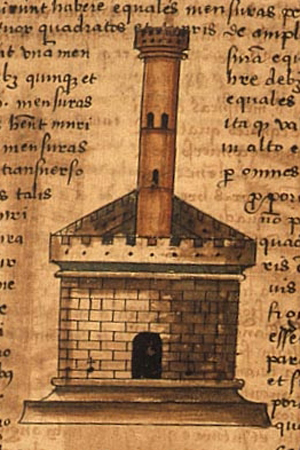
35. FIGURE OF A FORTRESS
This is a good figure to measure, and we want to
use it to provide a doctrine enabling one to find
the right measures for artificial structures according
to their use and proportion, like the pentagonal
figure which is more appropriate to the form of
a fortress than any other figure. Given that in
the pentagon, one measure is the means of four measures,
so likewise, the fortress walls must have equal
measures in all four squares, and the tower's width
must be of one measure equal to any of the 5, and
its height must be of 5 measures equal to the 5
measures of the walls, so that they are worth 5
measures vertically and 5 horizontally in all the
squares. Such a proportioned shape cannot be found
in a square figure because the tower would be too
short, and if the figure were hexagonal, then it
would have the same number as the walls and would
not be proportioned in the middle of the squares.
If the fortress were configured in a heptagonal
figure, the tower could not stand in the middle
of the 4 squares in a numerically natural way as
it does with the pentagonal figure. |
|
37. FIGURE OF A CHURCH OR PALACE WITH A TOWER,
OR A HALL WITHOUT A TOWER
The figure of a church or a palace with a tower,
or the figure of a hall without a tower is derived
from the 8 angled figure more properly than from
any other figure, so that the belfry, or tower
is 8 measures high and 2 wide, which make up a
quarter of 8, and the church's body is 4 measures
high and 8 measures long so it be as long as the
tower is high, and 4 measures in breadth so it
be immediately longer than it is wide, and it
is 4 measures high so that the length matches
the height. This proportionate measurement cannot
be found in any other figure that could be as
well suited to the purpose of a church, or palace
with a tower, or a hall without a tower, as the
figure with 8 angles, and this is visible in this
figure which is drawn according to the said measurements.
( Img://lullianarts.net/GNEnglish/037.html
) |
|
38. FIGURE OF A BEDROOM
A bedroom is a place for rest and sleep, and no
figure is as well suited to its purpose as the heptagon,
as shown in this figure which is 7 measures long,
2 measures wide, and 3 measures high including the
roof, and the reason why the best suited figure
of all is a heptagonal one, is that a bedroom cannot
concord with any other figure in view of the purpose
for which it provides shade. If its shape were quadrangular,
its form would not be conducive to rest, and a person
reclining in the room in which the master is reclining
would be too close to him, and if it were pentangular,
2 measures wide and 5 measures long, it would be
too wide, and if it were 1 measure wide and 5 long,
it would be too narrow and would not have the right
form; and likewise with the six angle figure as
2 measures of width would make it too wide and 1
measure would make it too narrow, and likewise with
the figure of 8 angles.
We have spoken of the method of measurement suited
to buildings according to the figures from which
they should be derived in view of their function
and use, and from the things we said about the said
figures, a doctrine can be derived for suitably
configuring the building of houses, portals and
public places, and this doctrine is useful for those
who love beautiful and well proportioned buildings.
|
|
Miniatura del llibre de las bestias
( Img: www.elmundomedieval.com) |
|
http://membres.lycos.fr/cat1714/images/llull2.pdf
Ver texto digitalizado
de los 3 sabios |
|
Ver
obras digitalizadas de Ramón Llull http://orbita.bib.ub.es/ramon/bo.asp
Ver Ramón Llull II
Ver Ramón LLull III:
Construcciones
|